The Keweenaw is one of the easiest places in the lower 48 to see a real auroral display. We're far enough north and dark enough — Lake Superior on three sides, Calumet's old mining towns dark by ten, and miles of empty shoreline that face the magnetic pole — that even a modest Kp 4 night can put the sky on fire. The trick is being ready when the alert pings.
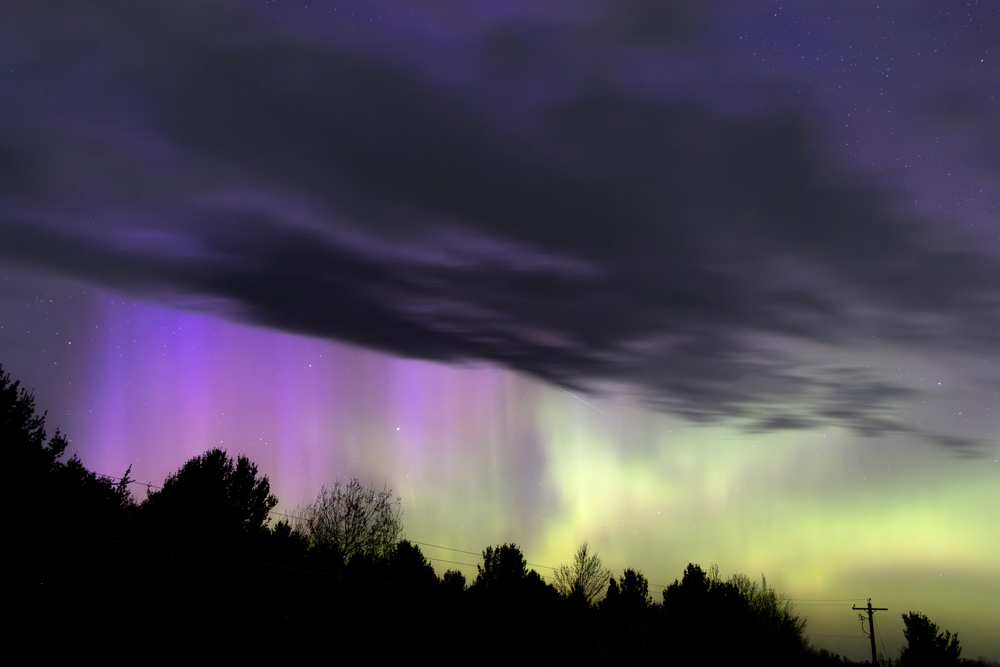
I shot the frame this post is built around from my own rooftop along the Portage Canal in Houghton — about a mile and a half from Breakers Beach at North Canal Township Park — at 15 seconds, f/4.5, ISO 2000 on a Canon 90D with the kit 18–135. Nothing exotic, no long drive. The settings were chosen because of how light, time, and noise trade against each other in the dark — not because the gear was fancy or the location was remote.
When and where in the Keweenaw
Aurora season runs strongest from September through April here, but the lights happen any month the sun is active. The Kp index is your friend — anything Kp 4 or higher with clear skies and a forecast pointing south on the Bz component is worth driving for. I keep the Aurora app on my phone for push alerts; it pulls from the NOAA Space Weather Prediction Center and pings me when a substorm is brewing, which is usually enough lead time to get the gear on the roof and the camera leveled.
The night this photo was taken (May 16, 2026) was a textbook example. Kp held above 4 from sunset on, with a real punch in the first window:
- 8:00 PM – 11:00 PM EDT: Kp 5.67 (G2 — Moderate)
- 11:00 PM – 2:00 AM EDT: Kp 5.33 (G1 — Minor)
- 2:00 AM – 5:00 AM EDT: Kp 4.67 (Active)
The frame at the top of this post was shot just after midnight, square in the middle of the G1 window — strong enough that the curtains were visible to the naked eye from the rooftop, even with the town's ambient glow.
For location, Eagle Harbor, Brockway Mountain, the Gay shoreline, and Hunter's Point in Copper Harbor all give you a clean northern horizon over Lake Superior. Breakers Beach at North Canal Township Park is another strong choice and a lot closer to town — once you walk out past the parking area, the town glow is behind you and you've got open water and a wide-open northern sky, with the breakwater's lines giving you a built-in leading-line foreground. Otherwise, get out of Houghton and Hancock if you can — the river-town glow is enough to wash out a weak show — though a strong display will punch through even from a rooftop in town, which is how the photo at the top of this post happened.
Common sense tips for shooting at night
Manual focus on a star. Autofocus has nothing to grab onto in the dark. Switch the lens to MF, point at the brightest star you can find, and flip on Live View at 10x magnification. The star will look like a small smeared blob. Slowly turn the focus ring and watch the blob — it will shrink as you approach correct focus and grow again as you pass it. The point where the star is at its smallest, sharpest pinpoint is true infinity for that lens at that temperature. Tape the focus ring with gaffer tape if you've got it. Recheck after every lens change or major temperature swing — focus drifts as glass contracts.
Bring a tripod and a remote trigger. Even a careful press on the shutter at 15 seconds adds shake. I use a small wireless remote — this Canon-compatible IR shutter release — so I can fire the camera without touching it. The 2-second self-timer works in a pinch, but a remote also lets you stand back from the camera and watch the sky instead of the LCD.
Shoot RAW and bracket. The aurora's brightness changes in real time. Take a frame, check the histogram, and adjust. Auto WB on the 90D handles aurora better than people give it credit for, but RAW lets you fix it cold or warm in post.
Kill all your light sources. Phone screens, dome lights, the back of your camera at full brightness — every one of those wrecks your night vision for twenty minutes and pollutes your neighbor's frame. Use a red headlamp, dim the LCD, and turn off the focus assist beam.
Dress for twenty degrees colder than the forecast. You're standing still in the dark on a lakeshore. Wind off Superior cuts straight through anything that isn't wool or down.
Why these settings
| Setting | Value | Why — for low/no light |
|---|---|---|
| Camera | Canon EOS 90D (APS-C) | Crop sensor, 32.5MP — high pixel density punishes noise, so ISO discipline matters more than on full-frame. Pair with a wide lens to compensate. |
| Lens | EF-S 18–135mm f/3.5–5.6 IS USM | Kit zoom, but plenty sharp at the wide end. Faster glass (f/2.8 or wider) would let you drop ISO or shutter — but this works. |
| Focal length | 18mm (≈29mm equiv.) | Wide enough to catch a full arc of aurora with foreground. Wider focal lengths also tolerate longer shutters before stars start trailing. |
| Aperture | f/4.5 | Near the lens's widest at 18mm (f/3.5). Wide aperture gathers maximum light. Depth of field is irrelevant when everything is at infinity. |
| Shutter | 15 seconds | Long enough to expose dim curtains of aurora, short enough to keep stars as points on APS-C at 18mm (the "500 rule" gives a ceiling around 17s here). |
| ISO | 2000 | Threads the needle — high enough to pull faint detail from the sky, below the 90D's ugly noise floor at 3200+. |
| Mode | Manual | The meter is useless when the scene is 90% black sky. You set every exposure variable yourself and read the histogram, not the needle. |
| Metering | Evaluative / multi-segment | Irrelevant in full manual — it's just what was set. Switch to spot if you ever drop into Av/Tv. |
| White balance | Auto | The 90D handles aurora reasonably. Many shooters lock to 3800K. With RAW, you can decide later. |
| Flash | Off | Obvious — but also turn off the AF assist beam, which fires automatically in low light on some bodies. |
Dangers to watch for
The footing. Keweenaw shoreline is cobble, basalt, and copper-mine tailings, often slick with spray. In the dark with one eye on a viewfinder, an ankle goes fast. Walk your composition in daylight first when you can.
Wildlife. Black bears and the occasional wolf are out at 2 AM in the Keweenaw, and they see you long before you see them. Make noise. Don't shoot solo in remote spots without telling someone where you are.
Cold and battery drain. Lithium batteries lose 30–50% of their capacity below freezing. Carry two or three spares in an inside pocket against your body. A frozen battery isn't dead — warm it up and it usually comes back.
Lens fog. The fastest way to ruin a night is bringing a cold lens into a warm car or a warm lens into cold air. Let the lens acclimate before you start shooting, and seal it in a zip bag before you bring it inside if you want to keep it dry.
The drive home. Two AM on US-41 with a tired photographer is more dangerous than any aurora setting. Stop in Calumet, get coffee, give yourself fifteen minutes before you point the truck south.
The Keweenaw will reward you for showing up. Bring a tripod, dress for the cold, and let the sky do the work.