
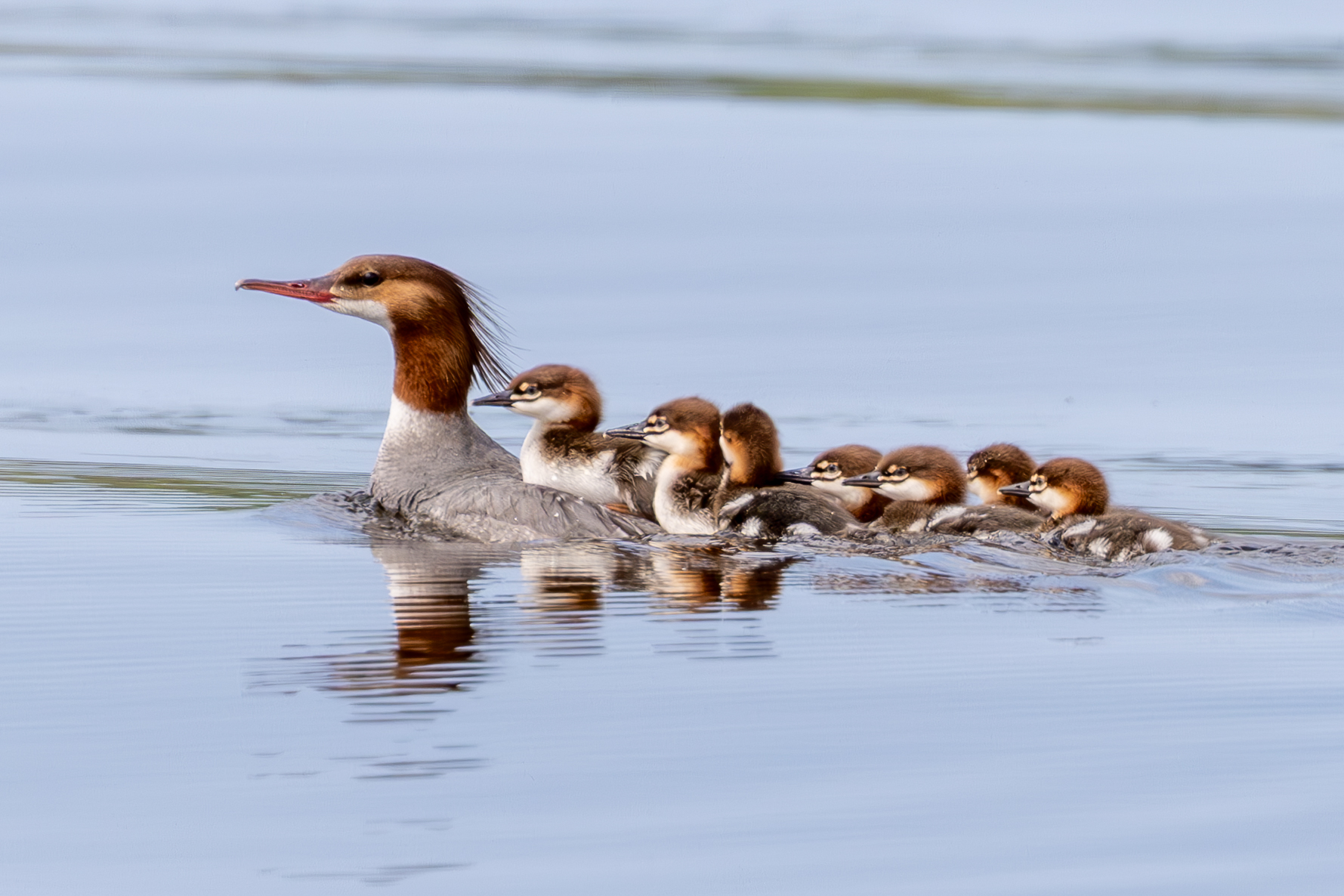
The 90D and the 100-400L II are not glamorous gear. There's no red ring envy at the trailhead, no influencer halo. But strapped together in the passenger seat of a dusty truck somewhere off US-41, this is the kit I reach for more than any other when I'm hunting birds in the U.P. The reach is real, the autofocus is honest, and the files hold up to the kind of cropping bird work demands.
The body: Canon EOS 90D
The 90D is a working camera. 32.5 megapixels on an APS-C sensor is a lot of pixels packed into a small space, and the practical upshot for birds is twofold. First, the 1.6x crop factor turns the 100-400 into the field-of-view equivalent of a 160-640mm — that's serious reach without serious weight. Second, even when a Black-throated Blue lands at the edge of usable range, you have pixels to spare for a tighter crop in post. The flip side: that pixel density punishes sloppy technique. Motion blur and noise both show up faster than they would on a full-frame body. You have to earn the file.
The 45-point all-cross-type autofocus array through the viewfinder is the other reason this body works for birds. It's quick, it's confident, and the spread covers enough of the frame that you can compose off-center without slipping focus onto a branch. Burst rate sits at roughly 10 frames per second through the viewfinder — plenty for a heron lifting off, more than enough for a song sparrow turning its head.
The glass: Canon EF 100-400mm f/4.5-5.6L IS II USM
The 100-400L II is the lens that earned my trust. The rotation-style zoom replaced the old push-pull design, and it makes a real difference in the field — you can adjust framing on a moving bird without rebalancing the whole rig. Autofocus is fast and largely silent, the optics are sharp wide open across the range, and the bokeh on a clean background is everything you'd want. Image Stabilization has three modes: Mode 1 for static or perched subjects, Mode 2 for panning a bird in flight, and Mode 3, which only kicks in during exposure — useful for erratic, unpredictable flight where you want a stable viewfinder image but don't want IS fighting your framing. On a sturdy tripod, switch IS off entirely — it can hunt and soften the frame. The tripod collar is also better than it has any right to be; I leave it on full-time and use it as a carry handle.
Manual with Auto ISO — why I shoot this way
For birds, I shoot Manual exposure with Auto ISO, and I'd argue it's the only mode that makes sense once you've used it. You lock shutter speed for the action you expect, you lock aperture for the depth and sharpness you want, and you let the camera ride ISO with the light. A heron flies from a shaded bank into open sun and your exposure tracks it in real time — you don't.
The trick most shooters miss: exposure compensation still works on the 90D in M+Auto ISO. Use it. Bias +1 to +1.7 for a white-breasted bird against dark water, -2/3 for a dark cormorant against a bright sky, and a touch positive whenever you're shooting into backlight. The histogram is your friend, not the meter.
Shutter, aperture, ISO ceiling
Shutter speed first. For birds in flight I want 1/2000 to 1/3200, no apologies. For a perched but alert bird — one that's about to launch — 1/1000. For a static, settled bird with IS on, I'll drop to a floor of 1/500, but no lower. The old rule of one over the focal length doesn't survive contact with a kingfisher. Birds blow past it.
Aperture is a tradeoff between subject isolation and AF margin. Wide open at f/5.6 at the 400mm end when the light is poor or when the background is busy and I want it to melt. f/7.1 to f/8 when I have the light to spare — a touch more bite across the bird's body, and a hair more depth so the AF can land on the eye rather than the wing.
I cap Auto ISO at 3200 on a bright day and let it run to 6400 when I have to. The 90D's sensor density makes noise less forgiving than a 5D-class body, so light discipline matters. Get up early. Stay out late. Don't try to fix bad light with ISO.
Autofocus and drive
Set the body to AI Servo and leave it there. Assign autofocus to the AF-ON button and take it off the shutter — back-button AF is non-negotiable for birds. You want to acquire focus, hold it through a burst, and release the button to lock without having to switch modes mid-sequence.
For point selection, I use Zone AF or Large Zone AF for birds in flight, where giving the system a small cluster of points to work with helps it stay on a moving target. For a perched bird, Single Point on the eye. The 90D offers AI Servo Cases 1 through 4 — Case 1 is the do-everything default and works for most situations; Case 2 ignores momentary obstacles, which is what you want when a bird ducks behind a reed and pops out the other side.
Drive mode is High-speed continuous, but short bursts. Three to five frames, then off the button. Machine-gunning fills the buffer at exactly the wrong moment, and the moment you miss is always the lift-off.
Technique: how to actually get the frame
Gear gets you in the room. Technique gets you the picture. Get low — eye level with the bird whenever the terrain allows. Get the eye sharp; if the eye isn't sharp, nothing else matters. Look for a catchlight in the eye, that tiny specular highlight that turns a record shot into a portrait. Shoot into clean, uncluttered backgrounds whenever you can choose them, even if it means waiting for the bird to move ten feet down the branch.
Work the golden hours. Side light at low angle does more for plumage texture than any sharpening slider. Learn the bird's behavior — kingfishers hover before they dive, herons coil before they strike, eagles lean forward and drop their tail a half-second before they leave the perch. If you know what's coming, you can pre-focus on a likely perch or gravel bar and wait. And use the car as a blind when you can. Birds tolerate vehicles in a way they will never tolerate a person on foot. Roll the window down, kill the engine, and let them come back to whatever they were doing before you got there.
The gear is honest. The birds are not impressed. Show up, do the work, and be grateful when they let you stay.